Free
Support
The Queen's Gallery was built in the shell of the former Holyrood Free Church and Duchess of Gordon’s School at the entrance to the Palace of Holyroodhouse. The buildings were constructed in the 1840s with funds from the Duchess of Gordon, but fell into disuse in the late 19th century. Benjamin Tindall Architects were appointed project architects for the new Queen’s Gallery in October 1999. Their central visual theme was a celebration of The Queen’s Golden Jubilee, expressed through a series of arches and screens that lead visitors from the Gallery entrance to the exhibition spaces beyond. Their design complements the original 19th-century architecture, elements of which were incorporated into the new spaces. Unsympathetic later internal alterations were removed, and a new exposed steel and concrete floor inserted to reflect the original ‘gallery’ of the Church. A new stone arched entrance was created at the centre of the Horse Wynd frontage, opposite the new Scottish Parliament building. The use of a stone archway, with a courtyard beyond, is a traditional entrance device in Scottish architecture. The main walling is of Catcastle stone, the dressed work and lettering is of Stainton stone and the base is of Kenmay granite. ‘THE QUEEN’S GALLERY’ lettering above the entrance is the work of John Neilson, a calligrapher and carver. The letters were cut from single pieces of stone. Above sits Scotland’s heraldic lion, designed by Jill Watson. The lion sedant is based on a small red lion that sits at the feet of Mary, Queen of Scots on her tomb in Westminster Abbey. (The Palace of Holyroodhouse was once home to Mary, Queen of Scots.) The monumental entrance doors of oak have gilded bronze hinges by Jill Watson. Continuing the heraldic theme, the main hinges are decorated with the Scottish lion and unicorn. The beasts are set against the adjacent urban scene of Edinburgh’s Royal Mile and the rural scene of Arthur’s Seat and Salisbury Crags. The upper hinges are made as golden boughs of flowering native trees – chestnut and laburnum, oak, rowan and hawthorn. The stone archway is decorated with a carved and gilded garland of Scottish flowers, including daisies and thistles, created by Graciela Ainsworth, an Edinburgh-based sculptor, carver and conservator. Over the old entrance to the former church is a stained-glass window by Christian Shaw. The design shows a perspective drawing of the interior of a gallery. At night, the shape of the archway is reflected by the glass lights by Keiko Mukaide set into the paving. The artist has given the tiles a water flow pattern, mirroring the stream of visitors walking in and out of the Gallery. Inside, the reception desk by Hamid van Koten is made from curved pieces of Scottish elm with kilned glass and patinated copper. The pendant lights were designed and made in Edinburgh by Ingrid Phillips. Dividing the reception from the main Gallery area is a patterned glass screen by Jacqueline Poncelet. The screen’s bronze handles by Jill Watson incorporate figures looking at art in a gallery. The dramatic central stair of native timber leads to the Gallery spaces above. The complex shape was designed by the architects with Charles Taylor Woodwork, who were responsible for the construction. Lights set into the first floor illuminate the curved balustrading. The Queen’s Gallery was opened by Her Majesty The Queen on 29 November 2002, as part of the Golden Jubilee celebrations. It hosts a programme of changing exhibitions from the Royal Collection.
For Tours:
Please plan to arrive 15 minutes prior to your tour time. Please bring your receipt or confirmation number.
Participants arriving after the tour departure time risk forfeiture of their tour seats.
Bike and Roll reserves the right to cancel any tour for weather or other reasons.
If the weather is questionable, please call one hour prior to the start time to confirm the tour status.
Set off for a full day excursion to Normandy from Paris with an official guide. Set off from your Paris accommodation at 06:30 for our central Paris agency. Relax during the journey by luxury air-conditioned coach before arriving at the Caen Memorial Museum at around 10:15. The Caen Memorial Museum retraces the various stages of the conflict that took place during the Second World War. Your guided tour will give you the chance to see everyday objects from life during occupation, maps, and models of military vehicles, as well as film screenings that recreate the emotions of D-Day and the Battle for Normandy. The visit continues with an included lunch at the restaurant in the Caen Memorial Museum. Menu* Starter Buffet: Légumes crus de saison et leur vinaigrette(tomates, concombres, carottes) Salades composées Charcuterie *** Table served hot dish Fondant de poulet farci aux cèpes Galette de pommes de terre / Julienne de légumes *** Chesse and Dessert Buffet: Fromages normands (Pont l’Evêque et Camembert) Tarte normande Salade de fruits Tarte au chocolat Teurgoule ** Pain de campagne (farmhouse bread) *** Drinks: Bordeaux wine (1 bottle for 4) Eau de source Coffee * Example of menu, subject to modification without any notice In the afternoon, your tour will continue to several of the iconic landmarks that played a part in the landings. Your first stop will be at the Pointe du Hoc, overlooking the hundred-foot-high cliffs. Stormed by the American Rangers on D-Day, it was one of the key German fortified sites along the Normandy coast and was equipped, at that time, with a number of heavy artillery posts. You will then visit the famous American Cemetery at Saint Laurent, located just above Omaha Beach. This 170-acre site is home to 9,387 perfectly aligned white marble headstones, a memorial, chapel, and the Garden of the Missing. It pays tribute to all the American soldiers who died during the Second World War. A small trail leads down the hill to Omaha Beach, giving you the opportunity to walk across the sand. You will have one hour to spend here. Following this visit, you will stop at Arromanches, a historic town known for its artificial port, which was built as part of the Normandy landings. The harbour saw the unloading of almost 10,000 tons of equipment. You can still make out the floating reinforced concrete "Phoenix" constructions in the water. Finally, you will make a short photo-stop near Juno Beach and its cemetery, one of the key D-Day landing beaches for Canadian troops. Return to your Paris accommodation is scheduled for around 21:30.
Windsor Castle, the largest and oldest occupied castle in the world, is one of the official residences of Her Majesty The Queen. The Castle's dramatic site encapsulates 900 years of British history. It covers an area of 26 acres and contains, as well as a royal palace, a magnificent chapel and the homes and workplaces of a large number of people. What there is to see: The magnificent State Apartments are furnished with some of the finest works of art from the Royal Collection, including paintings by Rembrandt, Rubens, Canaletto, Gainsborough and the famous triple portrait of Charles I by Sir Anthony van Dyck. In 1992 fire destroyed or damaged more than 100 rooms at the Castle. By good fortune the rooms worst affected were empty at the time, and as a result, few of the Castle's artistic treasures were destroyed. The highly acclaimed restoration work, completed in 1997, is a testament to the extraordinary skills of some of the finest craftsmen in Europe. From October to March visitors can also enjoy George IV's private apartments (the Semi-State Rooms), among the most richly decorated interiors in the Castle. St George's Chapel is one of the finest examples of Gothic architecture in England. It is the spiritual home of the Order of the Garter, the senior order of British Chivalry established in 1348 by Edward III. Within the chapel are the tombs of ten sovereigns, including Henry VIII and his third wife Jane Seymour, and Charles I. Among the highlights of a visit to Windsor is Queen Mary's Dolls' House, the most famous dolls' house in the world. The Drawings Gallery shows changing exhibitions of material from the Royal Library at Windsor Castle. The special display below is shown alongside a selection of treasures from the Royal Library.
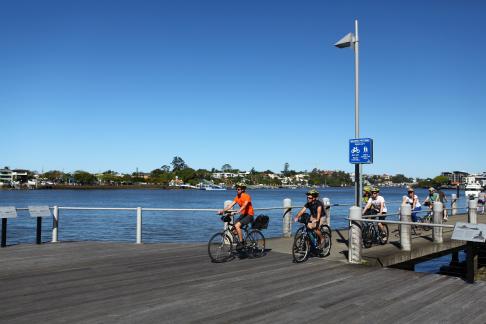
The ‘Eat Street Markets’ are set on an old disused container wharf. Come and enjoy everything from aromatic international cuisines and boutique beers, to the enchanting sights and sounds of live performers. Take a beautiful and leisurely ride around the twists and turns of the Brisbane River to experience Brisbane's best night food markets. The tour starts and finishes at Southbank Parklands. This is a unique opportunity and a delightful way to spend a Friday or Saturday evening in Brisbane. The entire route is on bike paths with no cars, and no hills! An ample amount of time (approx 1 - 1.5 hours) is available for you to explore the markets and try out the different food, drink and entertainment options. We return to Southbank Parklands via a comfortable boat cruise along the Brisbane river and witness the city come alive from a unique perspective. Your entry fee to the markets and river cruise is included in the ticket price. Any additional purchases are at your own expense. Please note that this tour requires a minimum of two people for the tour to go ahead.
Discover the romantic town of Paris in only 40 minutes !
The Little Train of Paris Montmartre offers a tour in the heart of Montmartre, with a return from la Place du Tertre. It also includes a full commentary with music.
This is a lovely way to go up Montmartre if you get on the train at Place Blanche and use it to go up to Place du Tertre. It is a steep way up to Montmartre and this is a great, and fun, alternative!
The Circuit:
Place Blanche
Place du Tertre
Place Constantin Pecqueur
Moulin Rouge
Espace Dali
La Halle et le Marché Saint-Pierre
Basilique du Sacré Coeur
Musée Montmartre
Anvers
Amphithéâtre / Arènes
Le Lapin Agile
Retour Place Blanche
Église Saint-Pierre
Cimetière Saint-Vincent
The Highlights:
Charming way to discover the famous district of Montmartre
Circuit of 14 stages to make your tour as detailed as possible
Please note that the ticket for the Paris Montmartre Little Train is valid from December 1st 2018 until 12/31/2019