Shakespeare's Globe Exhibition is the world's largest exhibition devoted to Shakespeare and the London in which he lived and worked. Housed beneath the reconstructed Globe Theatre on London's Bankside, the exhibition explores the remarkable story of the Globe, and brings Shakespeare's world to life using a range of interactive displays and live demonstrations.
Visitors to the exhibition can discover how shows were produced in the theatres of Shakespeare's time, from writing and rehearsals to music, dance and performance. There are opportunities to learn about the traditional crafts and techniques used during the process of rebuilding the Globe; to find out how special effects were produced in Shakespeare's time, to listen to recordings from some of the most memorable Shakespearean performances ever, or join the cast and add your own voice to a scene recorded by Globe actors; to create your own Shakespearean phrases in the word jungle; to watch a sword-fighting display and browse the costume collection, where you can learn about the extraordinary methods used in creating clothes 400 years ago.
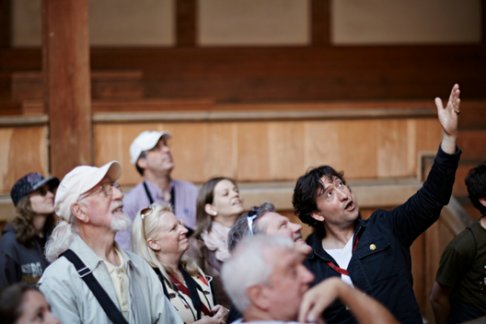
A visit to the Exhibition includes a guided tour of the theatre where expert guide-storytellers provide fascinating half hour tours of the auditorium, taking visitors on a journey through time back to Elizabethan London as well as the reconstruction process of the 1980's-90's and how the wooden 'o' works today as an imaginative and experimental theatrical space.
An exhibition visit and theatre tour lasts about one and a half hours. Information sheets are available in English, large print, German, French, Dutch, Spanish, Portuguese, Italian, Russian, Polish, Romanian, Chinese and Japanese.
NB: There is no access to the theatre during matinee performances. Visitors will be taken to the nearby archaeological site of the Rose Theatre, Bankside's first playhouse.
Tower Bridge Exhibition
Over 100 years ago, the Victorians built a bridge that has become one of London's most famous landmarks. High level walkways were built to allow people to cross the Thames whilst the Bridge was lifted to let tall ships sail past - Tower Bridge
Today these Walkways act as viewing galleries, giving visitors the most spectacular views across an ever changing London skyline.
Walkways & Exhibition:
Visitors enter Tower Bridge Exhibition via the North Tower. They are then transported by lift to the top of the Tower (47 metres above the Thames) where they have a unique opportunity to see the Bridge’s steel skeleton from within. A short film explains the history and provenance of the Bridge and then there is the chance to admire the spectacular views – from both covered Walkways.
Together with far-reaching views of East London, the walkway will be bolstered with a further 20 revered bridges in the extended popular display, ‘Great Bridges of the World’.
On the east Walkway there are fantastic views of the Docklands and from the west Walkway you can see the new GLA building, the Tower of London, St Paul’s, the city, the Pool of London and Big Ben and the London Eye in the distance.
Interactive computerised kiosks and graphic panels explain the significance of the views to visitors, as well as providing more information on the history and building of the Bridge. The interactive material and graphic panels are written in seven languages and an audio loop for the hard of hearing is also in place for the video show. There is another film to view in the South Tower before descending for the short walk to the historical Engine Rooms, included in your ticket price.
Victorian Engine Rooms:
These provide a fascinating insight into late 19th century engineering. Installed for the completion of Tower Bridge in 1894, these huge, and beautifully maintained, coal-driven engines were used to power the thousands of bascule Bridge lifts performed until 1976. Although lifts are now operated by electricity, the original steam engines are still in place. The Engine Rooms give visitors a chance to experiment with models demonstrating the technology behind the Bridge. There are also some amazing photographs of Tower BridgeTthroughout its lifetime – including a revealing picture of the heavy steel structure of the Bridge as the stone cladding was installed over it.