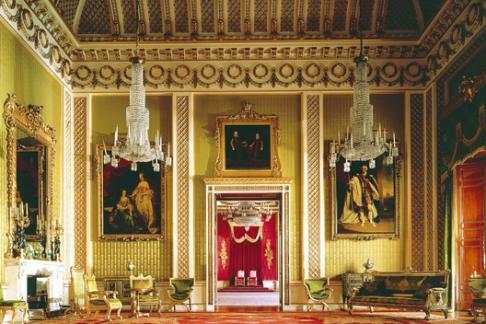
Buckingham Palace serves as both the office and London residence of Her Majesty The Queen, as well as the administrative headquarters of the Royal Household. It is one of the few working royal palaces remaining in the world today. Today the Buckingham Palace State Rooms are used extensively by Her Majesty The Queen and Members of the Royal Family to receive and entertain their guests on State, ceremonial and official occasions. During August and September when The Queen makes her annual visit to Scotland, the Palace's nineteen state rooms are open to visitors.
What there is to see?
The Buckingham Palace State Rooms form the heart of the working palace and are lavishly furnished with some of the greatest treasures from the Royal Collection - paintings by Rembrandt, Rubens, Poussin and Canaletto; sculpture by Canova; exquisite examples of Sèvres porcelain; and some of the finest English and French furniture.
In celebration of The Queen's 90th birthday, a special exhibition will be staged across each of Her Majesty's official residences during 2016.
Fashioning a Reign: 90 Years of Style from The Queen's Wardrobe (23 July – 2 October 2016)
The Garden
Described as a 'walled oasis in the middle of London', the Palace's garden is home to thirty different species of bird and more than 350 different wild flowers, some extremely rare. Visitors end their tour with a walk along the south side of the garden, with splendid views of the west front of the Palace and the famous lake.
Audio Guide
An audio guide is included in the ticket price and is available in English, French, German, Spanish, Italian, and Japanese, Russian and Mandarin. There is also a family audio guide (in English only) and accompanying activity trail, suitable for children 7-11 years.
Changing of the Guard
The Changing of the Guard ceremony takes place at 11:30 daily from April until the end of July and on alternate days for the rest of the year, weather permitting. The new guards arrive at the forecourt of the Palace at 11:30 from Wellington Barracks. The journey takes about 5 minutes and the soldiers are accompanied by a band. The ceremony is conducted on the Palace forecourt and takes approximately forty minutes to complete.
[The Army have not yet released the schedule for July, August or September.]
Wheelchair Access
If you require wheelchair access or the use of the lift, you should not book with 365 Tickets.com and should pre-book tickets directly with Buckingham Palace.
Access booking line: 020 7766 7324 www.royalcollection.org.uk or email [email protected]
Kensington Palace
Kensington Palace unveils a palace of secret stories and public lives. Visitors arrive through beautiful landscaped gardens evoking a past when Kensington was countryside. From the entrance hall start your journey through the magnificent Kings and Queen’s State Apartments. Filled with stories of two royal courts; the Stuarts and the Hanoverians, learn what you would have worn, how you should behave and how to succeed in the heady atmosphere of the palace state apartments.
Victoria Revealed, a fascinating exhibition, set within the rooms Victoria grew up in as a child, explores her life and reign in her own words with quotations from her intimate diaries. Imagine how she felt at just 17 years old on her first day as Queen at Kensington Palace, discover her romantic side through letters and gifts exchanged with Prince Albert and take a peep at moments of family life with her children and grand-children.
The glossy and glamorous exhibition, Fashion rules: gets a make-over, becoming Fashion rules: Restyled. A new collection of dress from the collections of HM Queen Elizabeth II, Princess Margaret and Diana Princess of Wales represents the story of the monarchy in the 20th century featuring rare and exquisite dresses from The Queen, Princesses Margaret and Diana, Princess of Wales. Discover how the royal figures and fashions were representative of the spirit of each decade. Surrounded by contemporary photography, film, music and including accessories, get a real sense of the 1950’s through to the 1990s, decades in which the clothes were worn and how they reflected and inspired everyday fashions.
Image Credits:
Image 1: Photographer: Derry Moore, Royal Collection Trust / © Her Majesty Queen Elizabeth II 2013
Image 2 : Photographer: Peter Smith, Royal Collection Trust / © Her Majesty Queen Elizabeth II 2013
Image 3 : Photographer: Andrew Holt, Royal Collection Trust / © Her Majesty Queen Elizabeth II 2013
Image 4: Photographer: Derry Moore, Royal Collection Trust / © Her Majesty Queen Elizabeth II 2013