London Eye
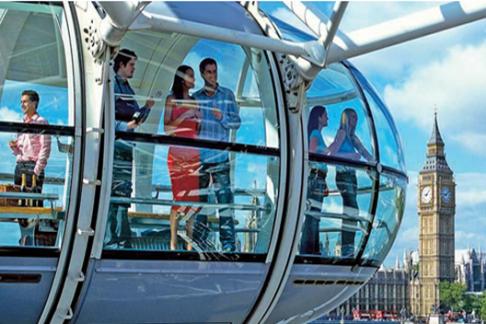
At 135 metres, the London Eye is the world's tallest observation wheel, with 40 kilometre panoramic views on a clear day. The gradual journey takes approximately 30 minutes and offers spectacular views of London and its famous landmarks such as Big Ben, Buckingham Palace and St Paul's Cathedral.
Now also included - London Eye 4D Experience!!!
The London Eye 4D Experience is a groundbreaking 3D film with in theatre effects, such as wind, bubbles and mist, to make the 4D. The film itself is a touching story of a little girl in London with her father. Her view of famous London landmarks is obscured by people and traffic, but a seagull draws her attention to The London Eye and her father takes her for an experience; finally she has an amazing view of the city. Colourful parties inside the capsule, time lapse of The London Eye day and night and a spectacular firework display all add up to an emotional and entertaining experience; the perfect prelude to an experience on The London Eye itself.
For a different perspective visit at sunset and see the city lights come on and the skyline awash with vibrant colours.
Developed to further enhance your experience, the guide book offers a panoramic map of London, pointing out all the landmarks you will see on your journey. It includes interesting facts and figures about London and tells the story behind the concept, design and construction of London's newest and most talked-about landmark.
The London Eye has 32 capsules, each carrying 25 guests, take you on a 30 minute journey through the most spectacular views of, over and around London spanning 25 miles in all directions.
Safety and security is our number one priority. For your safety and convenience, please read the following information on what items can and can not be taken on to the London Eye. Please be aware that all guests are subject to a security search when boarding the London Eye. Please note that the following items CAN be taken on board the London Eye:
· briefcases
· laptops
· small day size rucksacks and bags (maximum size 18" x 13" x 8" or 46cm x 33cm x 20cm)
· baby bags
The following items CAN NOT be taken on board the London Eye;
· large bags/suitcases or rucksacks
· motorcycle helmets
· skateboards and rollerblades
. tripods (unless agreed in advance with the London Eye)
· baby buggies*
· prohibited items**
If you are unsure .
* Baby buggies can be left at our 'Buggy' area facility in the ticket hall, although only for the duration of the experience.
** Prohibited items include sharp objects or anything which may be considered a security risk including penknives, scissors, metal nail files, toy or replica guns. If such objects are found or declared they will be checked in and returned to you after your experience providing the item is legal in the UK.
Terms and conditions
1. Confiscated objects are left entirely at the owner's risk at all times.
2. London Eye Company (LEC) accepts no responsibility for the loss of or damage to any objects left with LEC.
3. LEC is entitled to refuse to store any visitor's objects at its sole discretion whether for public safety reasons or any other reason.
Tower of London
One of the most famous buildings in the world, the Tower of London was constructed in the 11th century - almost a 1,000 years ago and has been witness to countless significant events in the development of Britain's now democratic monarchy.
During your tour of the Tower of London you will meet the magnificent Yeoman Warders or 'Beefeaters', clad as they were in Tudor times, hear the legend of the ravens and spine chilling tales from the Tower's long history. See the infamous Bloody Tower where the Princes were murdered, Beauchamp Tower where visitors can read carved inscriptions of past prisoners and Traitors Gate where those unlucky enough not to survive imprisonment had their heads impaled - and much more.
We sell at less than the gate price, which gives you access to all the Towers and Attractions, as well as the unique Gift Shops, the historic New Armouries Restaurant, Tower Cafe and Kiosk. Your Tower ticket also includes entry to the Crown Jewels.
Things to do and See at the Tower of London:
Line of Kings Exhibition
For over 300 years visitors to the Tower of London have marvelled at displays featuring arms and royal armour, life-sized wooden horses and figures of kings.
The White Tower
Currently hosting the Power House exhibition, about the various national institutions founded at the Tower of London, the White Tower is recognised as one of the most important historic buildings in the world. It has become an iconic symbol for Britain and London and is a must do on any trip to the Tower of London.
Entry to The White Tower is included in the Tower of London ticket price.
The Crown Jewels
The Jewel house at the Tower of London houses the world famous Crown Jewels. 23,578 precious stones and gems make up the Crown Jewels and include the world’s most famous diamond ‘ The Great Star of Africa’.
Entry to The Crown Jewels is included in the Tower of London ticket price.
The Yeoman Warder tours
The Yeoman Warders, also known as beefeaters, are the public face of the Tower of London. As well as guarding the Tower and Crown Jewels they also provide tours for visitor where they regale you with tales from the Tower.
Yeoman Warder Tours are included in the Tower of London Ticket Price
The Royal Beasts
The last thing you’d expect to see at the Tower of London would be Lions, Tigers, Elephants and Polar Bears, but for over 600 years the Royal Menagerie played host to these and many more. Discover their extraordinary stories and what life was like for them at the tower.
Entry to The Royal Menagerie is included in the Tower of London ticket price.
The Prisoners Exhibition
Aside from the Crown Jewels the Tower of London is probably best known for being a prison. Prisoners have been at the Tower almost since it was built and the new interactive displays in the Prisoners exhibition help children and adults explore their stories.
Entry to The Prisoners Exhibition is included in the Tower of London ticket price.
The Ravens
‘the kingdom and the Tower will fall if the six ravens ever leave the Tower of London’, well according to legend anyway. Whether this is true or not the ravens have become on of the Tower’s most famous sites, just make sure you see at least 6 when you visit!
The Tower Green
Believe it or not being executed inside the Tower of London was considered a privilege for those of high rank. The Tower Green contains a permanent memorial for those ‘lucky’ enough to be executed there.
The Medieval Palace
Being the oldest part of the Tower of London, the Medieval Palace contains amazing interiors that you won’t see anywhere else. here you can experience what life might have been like in a luxurious medieval household.
Entry to The Medieval Palace is included in the Tower of London ticket price.