Libre
Soutien

Come aboard mates! Make us part of your Orlando vacation. Voted "Best in Florida" by Orlando Magazine, our adventure golf courses are renowned for their innovative hole designs, lush landscaping, and entertaining pirate theming.
The adventures and legends of infamous pirates come to life as you enter our world of 18th century buccaneers--sunken ships, cascading waterfalls, dreaded pirate dungeons, and lush, tropical vegetation. And watch out for stray cannon shots from the wily skeleton lofting cannon fire from his old raft!
Our manicured courses are specifically designed to provide maximum enjoyment for kids and adults alike. Discover the fun!
Highlights
Brand new Pirate Ship! Fun for the whole family! 18 pirate-themed holes 2 courses to choose from!
Inclusions
Admission into Pirate's Cove One 18 hole golf course
Exclusions
Transportation to/from Pirate's Cove Optional gratuities Food and beverages
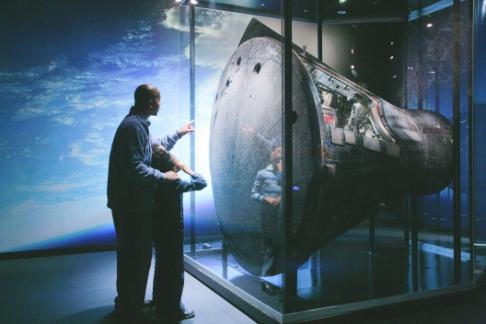
SKYDECK CHICAGO At 1,353 feet and 110 stories above the streets of downtown Chicago, The Ledge at the Willis Tower (formerly known as Sears Tower) Skydeck will transform any visitor's--or local's for that matter--experience with the Windy City. In January 2009, Willis Tower owners began a major renovation of the beloved Skydeck, which originally opened in 1974, and served as a premier tourist attraction throughout the skyscraper's tenure as the Sears Tower. When ownership changed hands, the fresh blood added a fresh look--and adrenaline rush--to the 103rd floor in the form of retractable glass balconies extending about 4 feet over Wacker Drive and the Chicago River below. Still the 8th tallest building in the world, and the absolute tallest in the Western Hemisphere, Willis Tower's Skydeck draws 1.5 million people a year who are eager to ascend the 110-story, 1,454 foot (443 meter) building for awesome panoramic views of the city and surrounding countryside. Your journey to the top of the Willis Tower starts with a walk through an airport-style metal detector, followed by a slow elevator ride down to the waiting area where visitors queue for tickets. A sign will tell you how long you'll have to wait to get up high; this is a good time to confirm the visibility. Even days that seem sunny can have upper-level haze that limits the view. On good days, however, you can see for 40 to 50 miles (64 to 80 kilometers), as far as the states of Indiana, Michigan. Iowa, and Wisconsin. While you wait, you can watch a film about Willis Tower factoids. Then you'll wait a little longer before the ear-popping, 70 second elevator ride up to the 103rd floor deck. From here, the entire city stretches below, and you can see exactly how Chicago is laid out. Willis Tower, Skydeck, and The Ledge Fast Facts The hundreds of forehead prints visitors left behind each week on Skydeck windows served as this inspiration for The Ledge. The Ledge boxes can each bear about 4-1/2 metric tons of weight, and adventurers who trust that statistic enough to prove it can often be found jumping and bounding around the entirely translucent enclosures as Chicago's heavy traffic and infrastructure bustle below. The Ledge’s glass panels weight 1,500 pounds apiece, and each box is comprised of three layers of half-inch thick glass laminated into one seamless unit. In addition to serving 1.3 million tourists per year in its 4.5+ million square feet of space, Willis Tower is home to more than 100 companies, including prominent law, insurance, transportation, and financial services. The Ledge's glass boxes retract into the Skydeck main floor for easy maintenance, probably mostly cleaning off the 974 dead birds that must fly into them every month. The Moonwalk is the most popular dance performed on The Ledge, followed closely by the Running Man. Riverdance clocks in at a distant third. Bringing people who are afraid of heights to The Ledge is not recommended, unless you are mean-spirited or really don't like them. In which case, you should probably just take them here. Willis Tower was known as Sears Tower for decades, until the 30th anniversary of Diff'rent Strokes, at which point it was rightfully renamed. ADLER PLANETARIUM Adler Planetarium Featured Shows: Planet Nine - In July 2015, the New Horizons spacecraft gave us our first close look at Pluto, the most famous dwarf planet in the outskirts of our Solar System. The New Horizons flyby was big news, and the pictures it continues to send back to Earth reveal a world far more complex than anyone realized. Destination Solar System - WHAT YOU WILL DISCOVER The year is 2096. Space tourism is booming, and you’ve signed up for a quick trip around the Solar System with Space Express Tours! In this live show, your guides are Jesse, a lovable rookie tour guide who can’t wait to show you the wonders of your celestial neighborhood, and Max, the much more experienced—if slightly grumpy—shipboard computer. With Max steering the ship and Jesse chattering excitedly about each place you visit, you’ll soar through the Asteroid Belt, explore the moons of Jupiter and Saturn, and hover over the roiling surface of the Sun. Hold on tight! Cosmic Wonder - WHAT YOU WILL DISCOVER Ever since the first curious person looked up at the night sky, people all over the world have challenged themselves to uncover its secrets. What are stars? How did they get there? Why does our view of the sky change throughout the year? What holds the Universe together? Skywatch Live - WHAT YOU WILL DISCOVER The Adler’s view of downtown Chicago is magnificent, but the lights of the city make it a little tough to see the ones in the sky. What’s a stargazer to do? Join us for Skywatch Live! In this show, your live presenter will turn down the city lights and crank up the stars to show you the night sky over Chicago like you’ve never seen it before. You’ll learn how to navigate by starlight, get to know the stars behind your favorite constellations, and witness the incomprehensible vastness of the Universe without ever leaving your seat. Earth, Moon & Sun - WHAT YOU WILL LEARN With the help of Coyote, an amusing character adapted from Native American oral traditions, kids will laugh and learn as they explore the relationship between the Earth, Moon, and Sun. Coyote has lots of misconceptions about our world, the universe, and well… just about everything. Coyote’s humorous mistaken ideas about the universe help the audience understand how the Earth, Moon, and Sun work together as a great big system. Undiscovered Worlds - WHAT YOU WILL DISCOVER Until very recently, the only planets known to us were the familiar worlds in orbit around our Sun. In the last two decades we have confirmed more than 1500 new planets, called exoplanets, orbiting other stars; thousands more are awaiting study. Undiscovered Worlds tells the tale surrounding this explosion of discovery and examines what will be required to determine which, if any, of these new exoplanets can support life. Welcome to the Universe - WHAT YOU WILL DISCOVER In Welcome to the Universe, you’ll get a clear picture of your place in this jaw-dropping cosmic landscape. With the guidance of a live presenter, you’ll explore the Pleiades star cluster, sail past the Andromeda galaxy, navigate the galaxies of the Coma Cluster, and discover hidden wonders of the Universe. One World, One Sky: Big Bird's Adventure - WHAT YOU WILL DISCOVER Join Big Bird and Elmo on an unforgettable journey to the Moon and back! When Elmo’s friend Hu Hu Zhu stops by Sesame Street for a visit, he notices that Sesame Street is a little bit different from his home in China. But when he looks up at the sky, he feels right at home. Elmo and Hu Hu Zhu may live in different cities, but they share the same sky! Featured Exhibits: (Temporary) - What is a Planet? - What You’ll See And Do: Witness how astronomers and the media reacted to Pluto’s reclassification in 2006. Learn what the current definition of a planet is and hear what Adler Astronomers think of the current definition. Voice your opinion about Pluto alongside skeptics and space enthusiasts through an interactive voting poll in real time. Explore artifacts from the Adler collections that illustrate the ever-evolving definition of a planet. This temporary exhibition, which is included with general admission, will be open to the public from March 19, 2016 through January 8, 2017. Mission Moon - WHAT YOU WILL DISCOVER Mission Moon invites you to experience America’s first steps into space through the eyes of NASA’s Captain James A. Lovell Jr. and his family. You’ll find out how the United States became the first nation to put a man on the Moon, what it’s really like to be an astronaut, and why it takes a team to explore uncharted worlds. Community Design Lab - In the Community Design Lab (CDL), you can test different materials to find out which ones will survive the journey to 100,000 feet above the Earth’s surface. Your discoveries may find their way into a future flight with Far Horizons, the Adler’s high-altitude ballooning program! If you could photograph an object in space, what would it be, and who would you share it with? In the CDL, you can build a DIY telescope-mount for your smartphone and become an instant astrophotographer! Test it out on one of our ’scopes and share your photos on social media. Our Solar System - WHAT YOU WILL DISCOVER Our Solar System is much more than a star and eight planets; it is home to a set of diverse and amazing objects that we are only beginning to understand. Pilot your own adventure in Our Solar System and explore the variety of objects currently orbiting our Sun. The Universe - A Walk Through Space & Time - WHAT YOU WILL DISCOVER Transport yourself to the distant corners of the cosmos and witness how the Universe evolved over 13.7 billion years, from the Big Bang to this morning’s sunrise. Follow the Universe from its meager beginnings and see how galaxies, stars, planets—and all the atoms in your body—were created as the Universe grew. Explore regions farther than our Solar System, billions of light-years from home. Zoom from one wondrous location in the Universe to another and investigate the most diverse and beautiful objects in deep space in ultra high resolution from the world’s most advanced telescopes. Planet Explorers - WHAT YOU WILL DISCOVER Are you interested in going to space and exploring other planets? Prepare for your out-of-this-world adventure in Planet Explorers. Begin by exploring your home, your backyard, and the sky above. What you discover will prepare you for your mission to space and the mysterious Planet X. Telescopes: Through the Looking Glass - WHAT YOU WILL DISCOVER Astronomers have studied the cosmos for thousands of years, but until about 400 years ago, they did it without telescopes! In Telescopes: Through the Looking Glass, you’ll find extraordinary beauty and technology in some of the world’s most important telescopes and learn how these clever light-catching devices helped us discover our Universe. Clark Family Gallery WHAT YOU WILL DISCOVER This futuristic, constantly changing environment features a one-of-a-kind architecture with vibrant lighting and video presentations. It was created using approximately 13,000 linear feet of aluminum tubing and 20,000 square yards of fabric. The gallery also has 125 LED lights, each capable of producing sixteen million different colors and over two billion different lighting combinations. Astronomy in Culture - WHAT YOU WILL DISCOVER Go back in time and learn about some of the people and societies who have challenged themselves to understand our place in the Universe. This exhibition features spectacular astrolabes, armillary spheres, and sundials to illustrate the medieval European and Middle Eastern conception of the Universe. Visit our medieval classroom to find out how much different school was back then. Learn how to use early astronomy tools including astrolabes and sundials. Atwood Sphere - WHAT YOU WILL DISCOVER Experience the night sky over Chicago as it appeared in 1913 in the Atwood Sphere – Chicago’s oldest planetarium. Although the star positions have not changed since then, we can see only a small percentage of these stars in our current night sky due to light pollution. The sphere is seventeen feet in diameter and has 692 holes drilled through its metal surface. These holes allow light to enter and show the positions of the brightest stars in the night sky. Take a live guided tour of the Atwood Sphere and identify stars and the constellations they form.
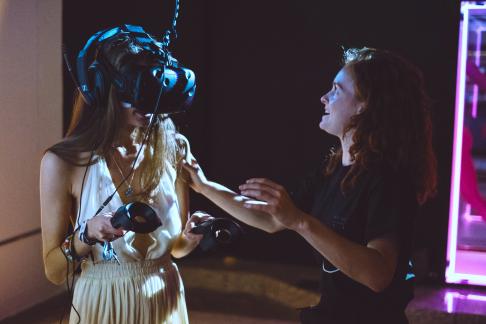
VR World There are a wide variety of experiences for all types of people. Some will enjoy shooting droids in space and fighting off zombies to racing on a track, while others will enjoy flying on a paraglider or climbing a mountain. Others still will enjoy watching short films or painting in the green room. Some experiences require full body motion while others are seated activities. Each participant gets approximately 5-10 minutes at each experience. At the gate, each participant will sign up using their real name, a screen name, an email, a phone number, and other pieces of information. While not required, if a participant signs up with their own phone number, they will receive a notification when they are at the the front of the queue for their attraction There are offering a wide selection of non-alcoholic drinks, beer, wine and liquor. Our house cocktails will not disappoint. Try the VRWorldian, Simon’s Escape, Caipirinha Assassin or Salty Borzoi to name just a few. No food at this time. There is no food inside the building, but guests are able to leave and re-enter the building during the time of their ticket. Empire State Building The world-famous 86th and 102nd floor Observatories offer unmatched views of New York City and on a clear day one can see to New Jersey, Connecticut, Massachusetts, Pennsylvania and Delaware. 1,050 feet above the city’s bustling streets, the 86th floor Observatory offers panoramic views from within a glass-enclosed pavilion and from the surrounding open-air promenade. 200 feet higher, our 102nd floor Observatory is a private and serene perch in the middle of the greatest city in the world. The Observatories have been a “must visit” for millions each year since it opened to the public in 1931. Each year approximately four million people are whisked to our 86th and 102nd floors, consistently one of New York City’s top tourist attractions. Visit the Observatories 365 days per year, day and night, rain or shine, for magnificent views of Manhattan and beyond. The Empire State Building embodies the feeling and spirit of New York City. It is recognized not only as an iconic landmark offering some of the most spectacular views on earth, but also as an international symbol of shared hopes, dreams, and accomplishment. Accessibility: The Empire State Building is fully ADA compliant. We have handicapped restrooms on the 86th Floor Observatory and also have lowered viewing walls and binoculars. Service dogs are allowed throughout the building. Motorized and non-motorized wheelchairs are permitted. The 86th Floor has ramps to make getting around easier and lowered viewing walls so that visitors in chairs can still take in the view.
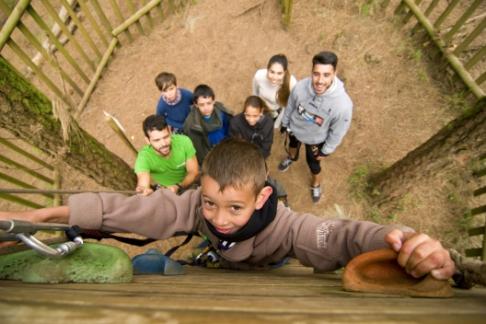
Your safety is paramount at Forestal Park and you will receive a full safety briefing on all the safety rules and mechanisms you will need at the park. You will also receive a full set of personal protective equipment. No special level of physical fitness is required and there are activities for all ages and physical abilities. So come and spend a day jam-packed with adventure, sports, nature and fun for the whole family. The maximum capacity of visitors to the park at a certain time is 110 adults and 30 children (in this case six to nine years) at the same time so the park is never too crowded. The time for the sports circuit is between two-and-a-half to three hours. And for the family circuit about two hours. You can enjoy only one circuit and the price is the same price for both the sporting circuit (participants must be at least 1.45 metres tall) and the family circuit (participants must be at least 1.10 metres in height). Children: 1.10 metres, minimum height six to 12 years inclusive.
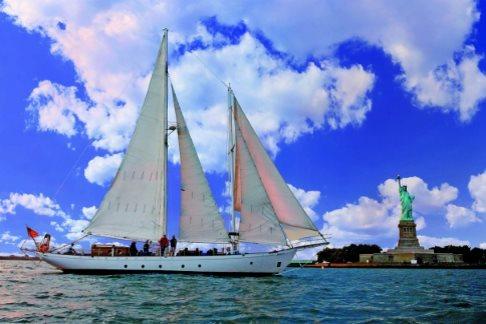
Shearwater is a classic Newport-style schooner yacht, only recently recognized as a national landmark in 2009. The vessel was built by Rice Brother Corporation in East Boothbay, Maine, back in a time when yachting was a rare combination of elegance and adventure; Rice Bros. were well known for building luxury pleasure yachts and produced some 4,000 hulls over a period of 64 years. The keel was laid down on January 4, 1929 and a news clip from the Boothbay Register reflects alongside a photograph "Tyler Hodgon at the old Tide Mill is getting out timbers for the schooner to be built at Rice’s. Vessel to be built of native white oak." Traditionally built from hand-hewn native white oak, she was the last boat to be constructed at that yard - likely due to the ensuing Great Depression brought on by the Stock Market Crash that occurred later that autumn. East Boothbay was a small coastal town with shipbuilding being its only industry. About 40 workmen were employed for the construction of SHEARWATER. Her designer Theodore Donald Wells was born in Hudson Falls, N Y on October 22, 1875. He was a naval architect and marine engineer, a member of the Society of Naval Architects and Marine Engineers and also the Institute of Naval Architects London. His education included post-graduate work at the University of Glasgow in Scotland. He began his career as a member of the firm Herreshoff and Wells, N. Y. City in 1902. Working with Herreshoff no doubt had an influence on his designs, which bear similarities to many of the famous Herreshoff designed yachts of that time. From 1903 to 1907 he worked for Wintringham and Wells and then began practicing his profession under his own name. Mr. Wells joined the Navy Department in March 1917 and became Superintending Constructor of the Baltimore District U. S. N. Notable yachts designed and constructed under his supervision are "Viking" a 272 foot steel motor yacht built for George F. Baker in 1929 by Newport News and "Karina" a three masted schooner built for Robert E. Tod in 1932 by Staten Island Shipbuilding. Mr. Tod was a well-known offshore yachtsman as was his former yacht ‘Thistle", which competed in the Emperors Cup ocean race. SHEARWATER was launched on May 4, 1929 and photographs in the Boothbay Register reflect her graceful and elegant lines. Her first Captain, Leon Esterbrook of Edgarton, MA, arrived to take charge of the fitting out. Her owner Charles E Dunlap was a member of the Seawanhaka Corinthian Yacht Club, Oyster Bay, NY and this became SHEARWATER’s first homeport after her completion in late September 1929. It was there in Oyster Bay that she first started to thrill those who sailed in luxury aboard her and those who were privileged to crew her on race day. Since her launching and documentation in Lloyd’s Register of American Yachts in 1929, she has had a colorful history and has been carefully maintained and restored to standards that few contemporary vessels are able to match and is truly a piece of American Maritime History. On November 7, 1942 SHEARWATER was requisitioned by the War Shipping Administration and became a member of The United States Coast Guard’s Coastal Picket Patrol during World War Two. She was painted gray and bore the numbers CG67004. Based at Little Creek, Virginia she patrolled the waters east of the Chesapeake Bay entrance and south towards Cape Hatteras. Her skipper during that period reflected on how they used their free time while out on submarine patrol to race against other yachts and in his own words "sailed in tandem with the schooner Lord Jim, racing in and out of port, up and down the east coast and winning." She was designed and built as a gaff rigged schooner but during this period was changed to a Marconi rig. She carries over 2,550 square feet while under full sail. A true veteran world cruiser, she first transited the Panama Canal in July 1946 and in the late 1970’s and early 1980’s completed a two and a half-year global circumnavigation. In December 1971 Mrs. John B. Thayer of Rosemont, wife of a former trustee and treasurer, donated SHEARWATER to the University of Pennsylvania’s Institute of Environmental Medicine. She was used by the university as a laboratory for research on physiological responses to the stresses of living and working underwater. Captained by James Shearson, she was fitted with compressors, generators, monitoring instruments and a small decompression chamber. She has participated in many Ancient Mariner and Classic yacht races in U S waters as well as racing in the Bay of Islands in New Zealand while on her circumnavigation in the early 1980’s. It is rumored she was once dismasted in the famous Newport to Bermuda race. She was last raced by the current owners in San Diego in May 1995 in the American Schooner Cup and finished second overall. She entered the yacht charter industry in 1966 whilst on the West Coast sailing to the Channel Islands and was again used to generate income to keep her shipshape while owned by the University of Pennsylvania. During the chartering industry’s infancy in the Caribbean, SHEARWATER was known as the " Queen of the Fleet". Today she continues this tradition offering the most unique sailing experience and has passed rigid Coast Guard inspections and can carry up to 49 passengers. We welcome you to join us for an excellent opportunity to experience the ambiance of a vintage sailing vessel while delighting in the splendors of The Manhattan sky-line, the Statue of Liberty or the beauty of the oceans beyond.
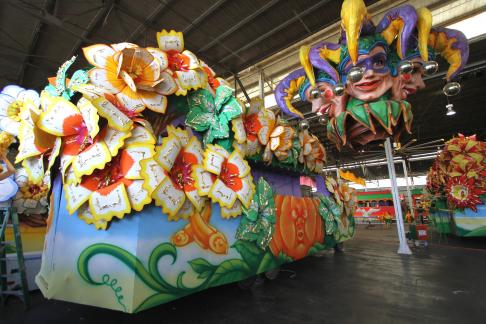
MARDI GRAS WORLD: WHERE MARDI GRAS IS MADE! There are plenty of tours in New Orleans, but only one offers a real, behind-the-scenes look at New Orleans Mardi Gras, and that’s the Mardi Gras World tour. Mardi Gras World gives you an authentic Mardi Gras experience all year round, whether you visit while sightseeing in New Orleans, enjoying a New Orleans family vacation or taking a break from your business trip. Take our day tour to see what it takes to bring Mardi Gras to life year after year. Our tour allows you to see firsthand the hard work and extensive planning that goes into this grand event. Since 1947, Blaine Kern Studios has built the breathtaking parade floats for major parades not only for Mardi Gras, but for parades all over the world. Mardi Gras parades would be nothing without the fantastical floats that line the parade route year after year. The hard work that goes into making these spectacles is what makes Mardi Gras in New Orleans the greatest show on Earth! Our knowledgeable guides take the mask off Mardi Gras with an all-access Mardi Gras tour, winding through the massive studio where these magnificent floats are built from the ground up. You’ll learn about the history of this unique and festive tradition and go beyond its reputation to get a deeper understanding of the real Mardi Gras. The whole family will love the experience of touring the space where our artisans create spectacular floats for over 40 parades each year. There are plenty of opportunities for photos in front of floats, with props, or wearing a traditional Mardi Gras costume on this New Orleans tour. This is an experience you will want to document, so don’t forget to bring your camera! A FREE shuttle is provided with ticket purchase, and has pick-ups at 20 convenient downtown locations. Just call 504-361-7821 to see where our designated pick up locations are. Call when you are at one of our many locations and we will quickly pick you and your party up. If you do not wish to use our complimentary shuttle, the closest parking is available in Lot J across from the Mardi Gras World entrance. ($15.00/vehicle, owned by the New Orleans Convention Center, subject to change) Wandering through the magical float den is an exciting experience for kids and adults alike, so come join us for the best Mardi Gras tour around.