Gratis
Apoyo
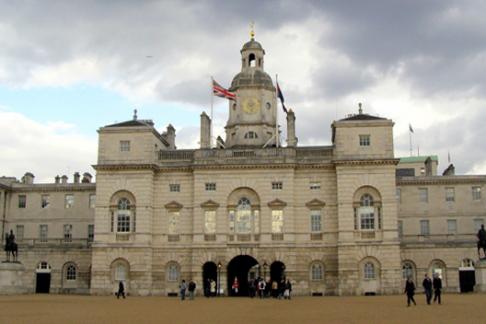
Historic setting: The Household Cavalry Museum sits within Horse Guards in Whitehall, central London, one of the city’s most historic buildings. Dating from 1750, it is still the headquarters of the Household Division, in which the Household Cavalry has performed the Queen’s Life Guard in a daily ceremony that has remained broadly unchanged for over 350 years. The Household Cavalry: The Household Cavalry was formed in 1661 under the direct order of King Charles II and now consists of the two senior regiments of the British Army – The Life Guards and the Blues and Royals. We have two roles: as a mounted regiment (on horseback), we guard Her Majesty The Queen on ceremonial occasions in London and across the UK and are a key part of the Royal pageantry; as an operational regiment we serve around the world in armoured fighting vehicles. We currently have units deployed on active service in Iraq and Afghanistan. Our fighting capacity is matched by our strategic role in international peace keeping and humanitarian operations. Collections: Over the centuries we have amassed an outstanding collection of rare and unique treasures from ceremonial uniforms, royal standards and gallantry awards to musical instruments, horse furniture and silverware by Fabergé. Each exhibit has its own compelling story to tell and many are on display for the very first time. You can see two silver kettledrums given to the regiment in 1831 by William IV; the pistol ball that wounded Sir Robert Hill at Waterloo and the cork leg which belonged to the first Marquess of Anglesy, who, as the Earl of Uxbridge, lost his real one at Waterloo. Modern additions to the collection include Jacky Charlton’s football cap – he did his national service with the regiment and Sefton’s bridle – the horse that was injured in the 1982 Hyde Park bombings. Much of the collection has resulted from the close association that has existed between the Household Cavalry and Royalty. We have, after all, protected successive kings and queens from rebels, rioters and assassins for nearly 350 years. Working Stable Block: Visitors can gain a unique behind-the-scenes look at our working stable block. All the horses here are on duty and at different times of the day you will see something going on - you might see the horses being brought in, groomed, fed and watered, their hooves oiled and shoes checked, their saddles adjusted ready to go on guard or just see the stables themselves being cleaned. Both our horses and riders go through a rigorous and demanding training. In the Museum's many interactive and multimedia presentations, you will hear first hand accounts of what this training is like and the techniques our soldiers use to master their horses and complete the gruelling preparations for regimental inspections.
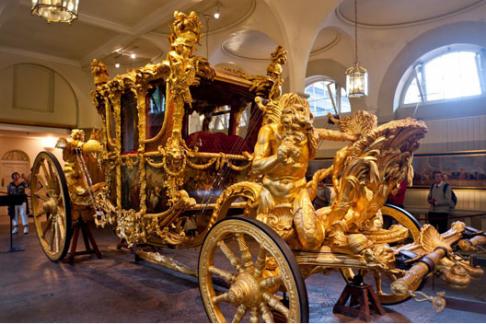
What there is to see: The Royal Mews is an important branch of the Lord Chamberlain's Office and provides road transport for The Queen and members of the Royal Family by both horse-drawn carriage and motor car. It is also one of the finest working stables still in existence, responsible for the training of the Windsor Greys and Cleveland Bays, the horses that pull the royal carriages. State vehicles are housed and maintained at the Royal Mews. They include the carriages used for royal and State occasions, such as State Visits, weddings and the State Opening of Parliament. Carriages from the Royal Mews are also used on roughly 50 occasions each year to convey newly appointed High Commissioners and Ambassadors from their official residence to Buckingham Palace to present their credentials to The Queen. Since 1843 the daily messenger Brougham has set out from the Royal Mews to collect and deliver post between Buckingham Palace and St James's Palace. The most dazzling of all coaches housed in the Royal Mews is the Gold State Coach, which has been used at every coronation since that of George IV in 1821 Multimedia guide is included in the admission price and is available in the following languages: English, French, German, Spanish, Italian, Japanese, Chinese, Russian Guided tours in English are available at intervals throughout the day. Guidebooks are available in English. wheelchair access number- 0303 123 7324 Outdated Royal Mews closures. Please direct readers to the Royal Collection Trust website's closures list to ensure they get up-to-date closure dates. Use the following copy:As a working royal residence, the site is subject to closure or partial closure at short notice, please check Royal Collection Trust's website for the latest closure dates: https://www.royalcollection.org.uk/travel-trade-and-groups/tour-planning
hattric-Geschenkgutschein über 50 Euro Sie möchten Freunden oder Verwandten eine Freude machen und habe keine Idee was Sie verschenken können? Wir haben die Lösung: Überreichen Sie als Präsent einen Geschenkgutschein von hattric! Und so einfach geht‘s: Sie bestellen hier diesen Gutschein und Sie erhalten in
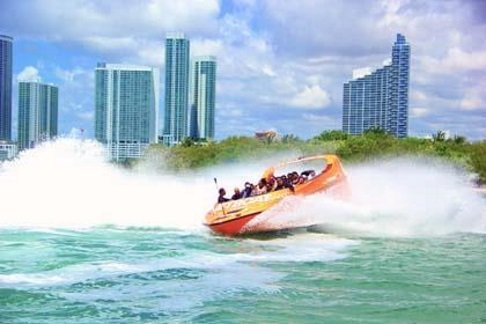
Restrictions Must be 10 or older with parental consent, 18 or older without consent. 100 lb minimum and 330 lb. weight max. Must sign waiver. Not suitable for pregnant women or people with heart or back problems. No Pickup/Drop-off service available. What to bring Just be ready to get wet! Life jackets are mandatory at all times but are provided on site.
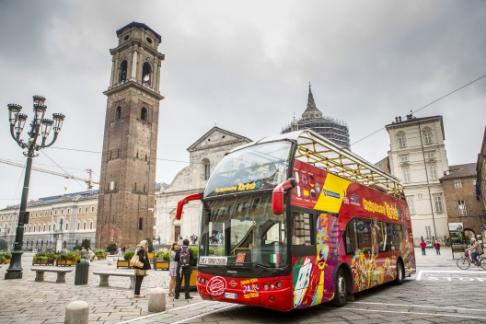
Please note: On occasion, due to events, some stops might not be guaranteed, updated tour stop information can be found at the bus stops or on the online app Line A Piazza Castello Mole Antonellina Villa della Regina Monte dei Cappuccini Borgo Medievale Parco del Valentino Piazza Carlo Felice Duomo
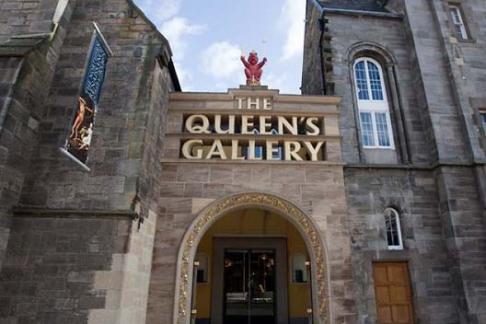
The Queen's Gallery was built in the shell of the former Holyrood Free Church and Duchess of Gordon’s School at the entrance to the Palace of Holyroodhouse. The buildings were constructed in the 1840s with funds from the Duchess of Gordon, but fell into disuse in the late 19th century. Benjamin Tindall Architects were appointed project architects for the new Queen’s Gallery in October 1999. Their central visual theme was a celebration of The Queen’s Golden Jubilee, expressed through a series of arches and screens that lead visitors from the Gallery entrance to the exhibition spaces beyond. Their design complements the original 19th-century architecture, elements of which were incorporated into the new spaces. Unsympathetic later internal alterations were removed, and a new exposed steel and concrete floor inserted to reflect the original ‘gallery’ of the Church. A new stone arched entrance was created at the centre of the Horse Wynd frontage, opposite the new Scottish Parliament building. The use of a stone archway, with a courtyard beyond, is a traditional entrance device in Scottish architecture. The main walling is of Catcastle stone, the dressed work and lettering is of Stainton stone and the base is of Kenmay granite. ‘THE QUEEN’S GALLERY’ lettering above the entrance is the work of John Neilson, a calligrapher and carver. The letters were cut from single pieces of stone. Above sits Scotland’s heraldic lion, designed by Jill Watson. The lion sedant is based on a small red lion that sits at the feet of Mary, Queen of Scots on her tomb in Westminster Abbey. (The Palace of Holyroodhouse was once home to Mary, Queen of Scots.) The monumental entrance doors of oak have gilded bronze hinges by Jill Watson. Continuing the heraldic theme, the main hinges are decorated with the Scottish lion and unicorn. The beasts are set against the adjacent urban scene of Edinburgh’s Royal Mile and the rural scene of Arthur’s Seat and Salisbury Crags. The upper hinges are made as golden boughs of flowering native trees – chestnut and laburnum, oak, rowan and hawthorn. The stone archway is decorated with a carved and gilded garland of Scottish flowers, including daisies and thistles, created by Graciela Ainsworth, an Edinburgh-based sculptor, carver and conservator. Over the old entrance to the former church is a stained-glass window by Christian Shaw. The design shows a perspective drawing of the interior of a gallery. At night, the shape of the archway is reflected by the glass lights by Keiko Mukaide set into the paving. The artist has given the tiles a water flow pattern, mirroring the stream of visitors walking in and out of the Gallery. Inside, the reception desk by Hamid van Koten is made from curved pieces of Scottish elm with kilned glass and patinated copper. The pendant lights were designed and made in Edinburgh by Ingrid Phillips. Dividing the reception from the main Gallery area is a patterned glass screen by Jacqueline Poncelet. The screen’s bronze handles by Jill Watson incorporate figures looking at art in a gallery. The dramatic central stair of native timber leads to the Gallery spaces above. The complex shape was designed by the architects with Charles Taylor Woodwork, who were responsible for the construction. Lights set into the first floor illuminate the curved balustrading.