Kostenlos
Unterstützung
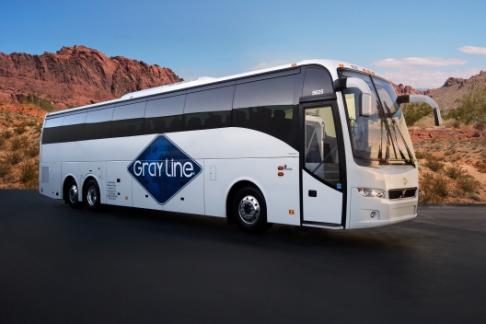
Get ready for a Wild West adventure at the Grand Canyon West Rim! Your professional driver / guide will provide expert live narration en route to the Grand Canyon from Las Vegas, while you sit back and relax in true luxury on board our state of the art luxury motor coaches. Your tour will begin with a photo stop of the Hoover Dam taken from the amazing O’Callaghan-Tillman Bridge, with enough time to enjoy the majesty of this engineering masterpiece, take some photos, then back on the road to the Grand Canyon. Listen to your friendly and knowledgeable guide offer expert narration as you travel through the ancient Joshua Tree Forest en route to the West Rim of the Grand Canyon for approximately 4 hours of sightseeing and exploration time. Don't forget to add the Skywalk tickets to your experience and walk the Sky! Experience breathtaking views of the Grand Canyon at Eagle Point from the Skywalk with unparalleled views from this unique glass and steel structure. You will also enjoy an exhilarating Helicopter and Pontoon attraction which will take you on a breathtaking descent into the Grand Canyon landing about 100 feet away from the Colorado river. From there you will be taken by a native guide down the Colorado river on a relaxing 20 minute cruise as you witness towering cliffs of the Grand Canyon from the calm water. All vehicles offer WI-FI on all tours: 15 minutes - free up to 25MB 1 hour - $2.95 up to 255MB 3 hours - $4.95 up to 655 MB 24 hours - $14.95 up to 1000 MB
HMS Belfast One of the most powerful large light cruisers ever built, HMS Belfast is now the only surviving vessel of her type to have seen active service during the Second World War. HMS Belfast played a leading part in the destruction of the battle cruiser Scharnhorst, and also the Normandy Landings. In service with the Royal Navy until 1965, she was saved for the nation in 1971 as a unique reminder of Britain’s naval heritage. Launch! Shipbuilding Through the Ages This new family-orientated exhibition will use hands-on and computerised interactive displays and engaging film and footage to demonstrate techniques of shipbuilding, from the ‘age of sail’ to modern prefabrication methods. The exhibition will focus on the science, engineering and social history of shipbuilding in Great Britain, and the interactive elements of the exhibition will allow children of all ages to get involved and experience this history. Explore ‘What shall we give in return for so much?’ One of the most powerful large light cruisers ever built, HMS Belfast is now the only surviving vessel of her type to have seen active service during the Second World War. Serving Britain for 32 years, she played an important role in both the Second World War and the Korean War as well as performing peacekeeping duties throughout the 1950s and 1960s. Saved from destruction in 1971, HMS Belfast is now part of the Imperial War Museum and is the first ship to be preserved for the nation since Nelson’s Victory. Through its team of staff and volunteers – many of whom are veteran crew – the Imperial War Museum is dedicated to making sure that HMS Belfast still has a role to play in reminding visitors of her unique place in Britain’s maritime heritage. History of HMS Belfast The term 'cruiser' goes back to the days of sailing ships when large frigates could be detached from the main fleet to cruise independently. The sailing cruiser, like her twentieth-century counterpart, was sufficiently powerful and fast to attack and destroy enemy commerce raiders. During the nineteenth century when sail gave way to steam and wooden ships were replaced by those built of iron, and later of steel, the cruiser evolved into a powerful warship which was used to patrol the Empire trade routes and protect friendly merchant shipping. After the First World War (1914-1918) a single category of cruiser emerged whose size was indicated by the size of its guns; thus, HMS Belfast is a 6-inch cruiser, designed for the protection of trade, for offensive action, and as a powerful support for amphibious operations. Please note: children under 16 must be accompanied by an adult. Please allow 1½ - 2 hours for your visit. Tower Bridge Exhibition Walkways & Exhibition: Visitors enter Tower Bridge Exhibition via the North Tower. They are then transported by lift to the top of the Tower (47 metres above the Thames) where they have a unique opportunity to see the Bridge’s steel skeleton from within. A short film explains the history and provenance of the Bridge and then there is the chance to admire the spectacular views – from both covered Walkways. On Monday 1st December, Tower Bridge’s East Walkway will reopen with its own GLASS FLOOR, joining the West Walkway to complete our new-look exhibition. Together with far-reaching views of East London, the walkway will be bolstered with a further 20 revered bridges in the extended popular display, ‘Great Bridges of the World’. On the east Walkway there are fantastic views of the Docklands and from the west Walkway you can see the new GLA building, the Tower of London, St Paul’s, the city, the Pool of London and Big Ben and the London Eye in the distance. Interactive computerised kiosks and graphic panels explain the significance of the views to visitors, as well as providing more information on the history and building of the Bridge. The interactive material and graphic panels are written in seven languages and an audio loop for the hard of hearing is also in place for the video show. There is another film to view in the South Tower before descending for the short walk to the historical Engine Rooms, included in your ticket price. Victorian Engine Rooms: These provide a fascinating insight into late 19th century engineering. Installed for the completion of Tower Bridge in 1894, these huge, and beautifully maintained, coal-driven engines were used to power the thousands of bascule Bridge lifts performed until 1976. Although lifts are now operated by electricity, the original steam engines are still in place. The Engine Rooms give visitors a chance to experiment with models demonstrating the technology behind the Bridge. There are also some amazing photographs of Tower BridgeTthroughout its lifetime – including a revealing picture of the heavy steel structure of the Bridge as the stone cladding was installed over it.
iFLY welcome flyers from 3 to 103. If you have reasonable health and fitness you can fly. But do check the criteria below before you purchase tickets. There are a few exceptions: Flyers must be over 3 years of age. Participants must weigh less than 300 pounds. Participants who weigh between 260 and 300 pounds must bring this to the attention of an iFLY representative as additional restrictions and instructor scheduling limitations may apply. Women who are pregnant should not fly. Folks with recent back, neck and heart problems should check with a doctor before flying. iFLY recommends people with prior shoulder dislocations DO NOT FLY! Click below for a complete list of restrictions: https://www.iflyworld.com/flight-restrictions-and-requirements/
Your river cruise on London's oldest thoroughfare - the Royal Thames - is an opportunity to take a truly different view of London, passing some its best of historical landmarks the Thames offers including: Cleopatra's Needle — It is known as Cleopatra's Needle as it was brought to London from Alexandria, the royal city of Cleopatra. The Needle arrived in England after a horrendous journey by sea in 1878 South Bank — The South Bank is the cultural heart of London, home to the South Bank Centre, Old Vic, Young Vic, National Theatre, BFI IMAX, BFI Southbank as well as art galleries, such as the.gallery@oxo and Bargehouse. St Paul's Cathedral — designed by the court architect Sir Christopher Wren and built between 1675 and 1710 after its predecessor was destroyed in the Great Fire of London Millennium Bridge — London's Millennium Bridge is the first pedestrian river crossing over the Thames in central London for more than a century Tate Modern — the Tate Collection comprises the national collection of British art from the year 1500 to the present day and international modern art The Globe Theatre — Shakespeare's Globe is a unique international resource dedicated to the exploration of Shakespeare's work HMS Belfast — HMS Belfast is the largest surviving example of Britain's twentieth century naval power and is now a museum moored on the Thames between Tower and London Bridge Tower of London — the Tower of London is one of the world's most famous and spectacular fortresses Tower Bridge — Tower Bridge was completed in 1894, after 8 years of construction. Originally, London Bridge was the only crossing over the Thames. You can then visit the Victorian Engine Rooms, home to the original steam engines that used to power the Bridge lifts Docklands — Walk alongside the Tower walls and suddenly you are thrust into the most modern area of London. From Tower Bridge to the Royal Docks and the Isle of Dogs is one of the oldest areas of London, containing the wharfs, warehouses and ports along the River Thames. Canary Wharf — Canary Wharf is planned on a grand scale, yet with meticulous attention to detail. The estate extends to over 97 acres and is so called because when in use as a dock, many of the imports were from the Canary Islands. Approximately 14.1 million square feet of office and retail space has been constructed to date. Greenwich — Greenwich is recognised for its cultural heritage: the grandeur and sheer beauty of its buildings; the magnificent vistas and views across London;-its royal history, as the birthplace of both Henry VIII and Elizabeth I, among others;