Kostenlos
Unterstützung
Included Free hotel pick up at 09.30 or 14.00 Professional tour guide (during the city tour) Air-conditioned vehicle 1 drink of your choice (during the boat tour) Audio guide in 30 languages (on the boat) Not included Hotel drop-off Transfer to the pier Entrance fees Tips
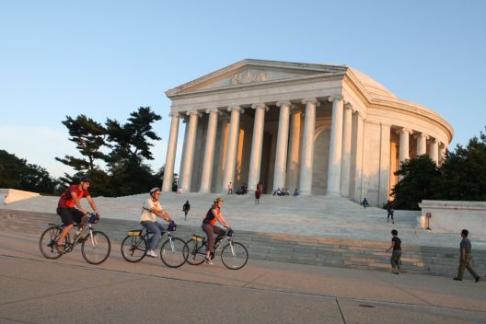
RED LOOP The official tour of the National Mall, authorized by the National Park Service and National Mall and Memorial Parks. Take in all the places that are synonymous with the nation’s Capital; The White House, U.S. Capitol, Air and Space Museum, Washington Monument, Jefferson Memorial, FDR Memorial and the Lincoln Memorial are just some of the iconic landmarks. Commentary provided in live guided commentary and in a choice of 8 pre-recorded languages. BLUE LOOP The Heroes tour travels to the sites and memorials honoring American heroes. Travel over the Potomac River leaving Washington, DC behind and visiting Virginia. The tour’s main features are Arlington National Cemetery, the Pentagon, the Pentagon City Fashion Center, and the US Marine Corps War Memorial (Iwo Jima Statue.) Other highlights include the Vietnam Veterans War Memorial, WWII Memorial and Air Force Memorial. Tour is available with live-guided commentary. YELLOW LOOP Travel through the city's historic center, passing the White House and Dupont Circle before heading out to discover Adams Morgan, the National Zoo, and the old world charm of Georgetown. Recorded commentary is available in your choice of 8 languages (French, German, Italian, Spanish, Chinese, Japanese, Portuguese and English available). PANORAMIC NIGHT TOUR Experience the Capital’s standout landmarks beautifully illuminated after dusk. Accompanied by your knowledgeable tour guide, you will be able to discover the stories behind Washington’s iconic landmarks. Your guide will explain the history of these national monuments and reveal the perfect position to capture the most impressive photos. DURATION: 2 Hours OPERATES: March 13- May 25: 19:00* May 26 to September 4: 19:30* September 5 to March 12: 18:30* *Departure from Willard Hotel is 30 minutes earlier. REDEMPTION INSTRUCTION: Redeem vouchers at either starting location: Union Station or Willard Hotel. Commentary The multi lingual tours provide a personal commentary in a choice of eight languages: English, French, Spanish, German, Italian, Mandarin, Japanese and Portuguese Your ticket will be valid for 48 hours from the first time you hop on the bus!
The State Rooms Buckingham Palace serves as both the office and London residence of Her Majesty The Queen, as well as the administrative headquarters of the Royal Household. It is one of the few working royal palaces remaining in the world today. Today the Buckingham Palace State Rooms are used extensively by Her Majesty The Queen and Members of the Royal Family to receive and entertain their guests on State, ceremonial and official occasions. During August and September when The Queen makes her annual visit to Scotland, the Palace's nineteen state rooms are open to visitors. What there is to see? The Buckingham Palace State Rooms form the heart of the working palace and are lavishly furnished with some of the greatest treasures from the Royal Collection - paintings by Rembrandt, Rubens, Poussin and Canaletto; sculpture by Canova; exquisite examples of Sèvres porcelain; and some of the finest English and French furniture. In celebration of The Queen's 90th birthday, a special exhibition will be staged across each of Her Majesty's official residences during 2016. Fashioning a Reign: 90 Years of Style from The Queen's Wardrobe (30 July – 25 September 2016) The Garden Described as a 'walled oasis in the middle of London', the Palace's garden is home to thirty different species of bird and more than 350 different wild flowers, some extremely rare. Visitors end their tour with a walk along the south side of the garden, with splendid views of the west front of the Palace and the famous lake. Audio Guide An audio guide is included in the ticket price and is available in English, French, German, Spanish, Italian, and Japanese, Russian and Mandarin. There is also a family audio guide (in English only) and accompanying activity trail, suitable for children 7-11 years. Changing of the Guard The Changing of the Guard ceremony takes place at 11:30 daily from April until the end of July and on alternate days for the rest of the year, weather permitting. The new guards arrive at the forecourt of the Palace at 11:30 from Wellington Barracks. The journey takes about 5 minutes and the soldiers are accompanied by a band. The ceremony is conducted on the Palace forecourt and takes approximately forty minutes to complete. [The Army have not yet released the schedule for July, August or September.] Wheelchair Access If you require wheelchair access or the use of the lift, you should not book with 365 Tickets.com and should pre-book tickets directly with Buckingham Palace. Access booking line: 020 7766 7324 www.royalcollection.org.uk or email [email protected]
The Queen's Gallery was built in the shell of the former Holyrood Free Church and Duchess of Gordon’s School at the entrance to the Palace of Holyroodhouse. The buildings were constructed in the 1840s with funds from the Duchess of Gordon, but fell into disuse in the late 19th century. Benjamin Tindall Architects were appointed project architects for the new Queen’s Gallery in October 1999. Their central visual theme was a celebration of The Queen’s Golden Jubilee, expressed through a series of arches and screens that lead visitors from the Gallery entrance to the exhibition spaces beyond. Their design complements the original 19th-century architecture, elements of which were incorporated into the new spaces. Unsympathetic later internal alterations were removed, and a new exposed steel and concrete floor inserted to reflect the original ‘gallery’ of the Church. A new stone arched entrance was created at the centre of the Horse Wynd frontage, opposite the new Scottish Parliament building. The use of a stone archway, with a courtyard beyond, is a traditional entrance device in Scottish architecture. The main walling is of Catcastle stone, the dressed work and lettering is of Stainton stone and the base is of Kenmay granite. ‘THE QUEEN’S GALLERY’ lettering above the entrance is the work of John Neilson, a calligrapher and carver. The letters were cut from single pieces of stone. Above sits Scotland’s heraldic lion, designed by Jill Watson. The lion sedant is based on a small red lion that sits at the feet of Mary, Queen of Scots on her tomb in Westminster Abbey. (The Palace of Holyroodhouse was once home to Mary, Queen of Scots.) The monumental entrance doors of oak have gilded bronze hinges by Jill Watson. Continuing the heraldic theme, the main hinges are decorated with the Scottish lion and unicorn. The beasts are set against the adjacent urban scene of Edinburgh’s Royal Mile and the rural scene of Arthur’s Seat and Salisbury Crags. The upper hinges are made as golden boughs of flowering native trees – chestnut and laburnum, oak, rowan and hawthorn. The stone archway is decorated with a carved and gilded garland of Scottish flowers, including daisies and thistles, created by Graciela Ainsworth, an Edinburgh-based sculptor, carver and conservator. Over the old entrance to the former church is a stained-glass window by Christian Shaw. The design shows a perspective drawing of the interior of a gallery. At night, the shape of the archway is reflected by the glass lights by Keiko Mukaide set into the paving. The artist has given the tiles a water flow pattern, mirroring the stream of visitors walking in and out of the Gallery. Inside, the reception desk by Hamid van Koten is made from curved pieces of Scottish elm with kilned glass and patinated copper. The pendant lights were designed and made in Edinburgh by Ingrid Phillips. Dividing the reception from the main Gallery area is a patterned glass screen by Jacqueline Poncelet. The screen’s bronze handles by Jill Watson incorporate figures looking at art in a gallery. The dramatic central stair of native timber leads to the Gallery spaces above. The complex shape was designed by the architects with Charles Taylor Woodwork, who were responsible for the construction. Lights set into the first floor illuminate the curved balustrading.
Get a taste of life on the ocean waves, including the chance to take the ship's wheel and learn how to steer 963 tons of Victorian tea clipper through storms and high seas Learn the story of one of the most famous and magnificent ships in the world Take in epic views of the London skyline. Initially built for the China tea trade and launched in 1869, Cutty Sark’s original wooden planks and iron frames have been meticulously conserved. As part of an ambitious six-year conservation project, the ship was raised over three metres, giving visitors the unique opportunity to stand directly underneath this world wonder and see her elegant lines and ground-breaking design. It has now been developed into an award-winning museum and visitor experience. Located in the UNESCO World Heritage Site of Maritime Greenwich, the National Maritime Museum and the Queen’s House are both located within a short walking distance from Cutty Sark and are free to visit. The Royal Observatory is another must-see attraction when visiting Greenwich; it’s the home of Greenwich Mean Time and the Prime Meridian.
Buckingham Palace serves as both the office and London residence of Her Majesty The Queen, as well as the administrative headquarters of the Royal Household. It is one of the few working royal palaces remaining in the world today. Today the Buckingham Palace State Rooms are used extensively by Her Majesty The Queen and Members of the Royal Family to receive and entertain their guests on State, ceremonial and official occasions. During August and September when The Queen makes her annual visit to Scotland, the Palace's nineteen state rooms are open to visitors. What there is to see? The Buckingham Palace State Rooms form the heart of the working palace and are lavishly furnished with some of the greatest treasures from the Royal Collection - paintings by Rembrandt, Rubens, Poussin and Canaletto; sculpture by Canova; exquisite examples of Sèvres porcelain; and some of the finest English and French furniture. In celebration of The Queen's 90th birthday, a special exhibition will be staged across each of Her Majesty's official residences during 2016. Fashioning a Reign: 90 Years of Style from The Queen's Wardrobe (23 July – 2 October 2016) The Garden Described as a 'walled oasis in the middle of London', the Palace's garden is home to thirty different species of bird and more than 350 different wild flowers, some extremely rare. Visitors end their tour with a walk along the south side of the garden, with splendid views of the west front of the Palace and the famous lake. Audio Guide An audio guide is included in the ticket price and is available in English, French, German, Spanish, Italian, and Japanese, Russian and Mandarin. There is also a family audio guide (in English only) and accompanying activity trail, suitable for children 7-11 years. Changing of the Guard The Changing of the Guard ceremony takes place at 11:30 daily from April until the end of July and on alternate days for the rest of the year, weather permitting. The new guards arrive at the forecourt of the Palace at 11:30 from Wellington Barracks. The journey takes about 5 minutes and the soldiers are accompanied by a band. The ceremony is conducted on the Palace forecourt and takes approximately forty minutes to complete. [The Army have not yet released the schedule for July, August or September.] Wheelchair Access If you require wheelchair access or the use of the lift, you should not book with 365 Tickets.com and should pre-book tickets directly with Buckingham Palace. Access booking line: 020 7766 7324 www.royalcollection.org.uk or email [email protected] Windsor Castle, the largest and oldest occupied castle in the world, is one of the official residences of Her Majesty The Queen. The Castle's dramatic site encapsulates 900 years of British history. It covers an area of 26 acres and contains, as well as a royal palace, a magnificent chapel and the homes and workplaces of a large number of people. Kew Gardens Kew Gardens, is a World Heritage Site located in 121 hectares of stunning vistas with six magnificent glasshouses set in a beautiful landscape beside the River Thames between Richmond and KEW in south-west London. Kew Gardens represents more than 250 years of historical gardens. It is home to a remarkable collection of over 30,000 types of plants from all over the world that range from the decorative to the peculiar. Kew Gardens provide opportunities for public enjoyment and enrichment and the behind-the-scenes scientific work helps ensure a sustainable future for plants and people. In the summer of 2004, Kew's determination to make serious botany great fun for children was demonstrated with the opening of 'Climbers and Creepers'. Bringing a new use to an old cycad house by White Peaks, Climbers and Creepers engages children from around 3-9 years in the pleasures of learning more about plants and their relationships with animals and people. Apart from the sheer beauty and tranquillity of the garden's landscapes Kew offers a wonderful day out for all, whether horticulturally, historically or botanically inclined. Botanical Highlights The dates below are approximate, and flowering can vary by three to four weeks, depending on the weather. Image Credits: Image 1: Photographer: Derry Moore, Royal Collection Trust / © Her Majesty Queen Elizabeth II 2013 Image 2 : Photographer: Peter Smith, Royal Collection Trust / © Her Majesty Queen Elizabeth II 2013 Image 3 : Photographer: Andrew Holt, Royal Collection Trust / © Her Majesty Queen Elizabeth II 2013 Image 4: Photographer: Derry Moore, Royal Collection Trust / © Her Majesty Queen Elizabeth II 2013