Arcelormittal Orbit
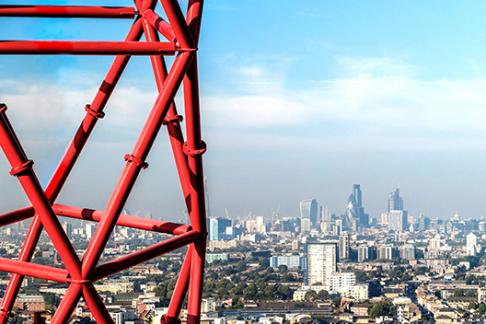
Feel the ground disappear as you make the short journey by lift, 80m to the top viewing platform of the ArcelorMittal Orbit where you will experience a show-stopping panorama.
Take in a totally new perspective of London with views of up to 20 miles into the city and over the parklands, waterways and world-class sporting venues of London’s newest Park, Queen Elizabeth Olympic Park. The wave-shaped roof of the Aquatics Centre can be seen in its full glory, now the temporary spectator wings have been removed. Take a hawk’s eye view over the magnificent Stadium, the future new home of West Ham United Football Club and look down on the unique and intimate gardens of the newly landscaped south of the Park.
Looking beyond the Park, visitors to the ArcelorMittal Orbit will have the chance to see five football grounds, and many of London’s iconic buildings: The Shard, BT Tower, The Gherkin, Big Ben, Canary Wharf, the O2 Arena and Emirates Airline. Those with a keen eye will also spot new additions to the skyline, such as the Walkie Talkie and the Cheesegrater. And with views of up to 20 miles, marvel at the sights on the horizon from Alexandra Palace in the north, Wembley Stadium to the west, Crystal Palace transmitter to the south and Epping Forest to the east.
Along with the landscape, and visionary design of the sculpture itself, visitors will be treated to interactive screens using gigapixel technology to interpret the views. Learn the story of the ArcelorMittal Orbit and Queen Elizabeth Olympic Park (available in multiple languages) and take a closer view of the panorama using this innovative technology. Visitors can also enjoy the distinctive Kapoor designed concave mirrors that will flip your perspective and turn the horizon on its head.
And when it’s time to go home, challenge your friends and family to descend the 455 steps to the ground, immersing yourselves in the sounds of London as you walk down the stairs.
The ArcelorMittal Orbit is a distinctive emblem of the London 2012 Olympic and Paralympic Games, and illustrates the continuing story of that magical summer – follow in the footsteps of Her Majesty the Queen and many Olympic and Paralympic stars –ascend the ArcelorMittal Orbit – an unmissable London attraction.
Tower of London
One of the most famous buildings in the world, the Tower of London was constructed in the 11th century - almost a 1,000 years ago and has been witness to countless significant events in the development of Britain's now democratic monarchy.
During your tour of the Tower of London you will meet the magnificent Yeoman Warders or 'Beefeaters', clad as they were in Tudor times, hear the legend of the ravens and spine chilling tales from the Tower's long history. See the infamous Bloody Tower where the Princes were murdered, Beauchamp Tower where visitors can read carved inscriptions of past prisoners and Traitors Gate where those unlucky enough not to survive imprisonment had their heads impaled - and much more.
We sell at less than the gate price, which gives you access to all the Towers and Attractions, as well as the unique Gift Shops, the historic New Armouries Restaurant, Tower Cafe and Kiosk. Your Tower ticket also includes entry to the Crown Jewels.
Westminster Abbey
Glorious Architecture
This magnificent gothic construct is a sight to behold and the incredible stained glass is some of the most impressive in the UK.
Coronation Chair
Created for King Edward I in 1296, the chair has been the seat for the crowning of every monarch since 1308, including Queen Victoria and our current reigning Queen, HRH Elizabeth II. It is the oldest piece of furniture in the UK that is still used for its original intention.
Poets’ Corner
The literary corner of the Abbey is named due to the large amount of poets and writers buried there, including Geoffrey Chaucer, Charles Dickens, Rudyard Kipling and Thomas Hardy, as well as many memorial stones and busts dedicated to the likes of Shakespeare and loved Scottish poet Robert Burns.
Kings and Queens
Westminster Abbey has been the coronation church since 1066 and seventeen monarchs are buried there. The Abbey was also the place where William and Kate tied the knot in 2011.
Tower Bridge Exhibition
Tower Bridge Unveils New GLASS FLOOR Across High-Level Walkways
Launched in the West Walkway today, the glass floor offers visitors a never-seen-before view of London life, from 42 metres above the River Thames. Look down to spy road and pedestrian life whizzing over the Bridge while river vessels sail under it – and plan your visit in advance for the truly magical experience of the bascules being raised beneath your feet.
The glass floor measures 11 metres long by 1.8 metres wide and comprises of six panels weighing 530 kilograms each. It is made up of five thick layers and can hold the equivalent weight of an elephant and two taxis! The installation took a 20-strong team to construct it over a six week period.
The Walkways also offer stunning panoramic views of London while each of the 20 bridges featured in our popular and refreshed 'New Great Bridges of the World' display showcase a breath-taking feat of engineering. After learning about the history of the Bridge through animations and
displays in the Towers, continue to the Victorian Engine Rooms for the beautifully maintained steam engines that were once used to power the bridge lifts.
Over 100 years ago, the Victorians built a bridge that has become one of London's most famous landmarks. High level walkways were built to allow people to cross the Thames whilst the Bridge was lifted to let tall ships sail past - Tower Bridge
Today these Walkways act as viewing galleries, giving visitors the most spectacular views across an ever changing London skyline.
Walkways & Exhibition:
Visitors enter Tower Bridge Exhibition via the North Tower. They are then transported by lift to the top of the Tower (47 metres above the Thames) where they have a unique opportunity to see the Bridge’s steel skeleton from within. A short film explains the history and provenance of the Bridge and then there is the chance to admire the spectacular views – from both covered Walkways.
On the east Walkway there are fantastic views of the Docklands and from the west Walkway you can see the new GLA building, the Tower of London, St Paul’s, the city, the Pool of London and Big Ben and the London Eye in the distance.
Interactive computerised kiosks and graphic panels explain the significance of the views to visitors, as well as providing more information on the history and building of the Bridge. The interactive material and graphic panels are written in seven languages and an audio loop for the hard of hearing is also in place for the video show. There is another film to view in the South Tower before descending for the short walk to the historical Engine Rooms, included in your ticket price.
Victorian Engine Rooms:
These provide a fascinating insight into late 19th century engineering. Installed for the completion of Tower Bridge in 1894, these huge, and beautifully maintained, coal-driven engines were used to power the thousands of bascule Bridge lifts performed until 1976. Although lifts are now operated by electricity, the original steam engines are still in place. The Engine Rooms give visitors a chance to experiment with models demonstrating the technology behind the Bridge. There are also some amazing photographs of Tower BridgeTthroughout its lifetime – including a revealing picture of the heavy steel structure of the Bridge as the stone cladding was installed over it.